
Beatbox basics
Boots and Cats – the beat everyone starts with
Say „boots and cats and boots and cats“ out loud, over and over, and speed it up. That is it. That is beatboxing.
It sounds too simple to be real, and that is exactly why it works. Those four words hide the three sounds almost every beat in the world is built from – a kick drum, a hi-hat and a snare. The phrase does the hard part for you: it puts them in the right order and in the right rhythm before you even know what you are doing.
This page takes you from the phrase to an actual beat in about ten minutes.
What „boots and cats“ actually means
| Word | Sound it becomes | In a drum kit |
|---|---|---|
| Boots | B + ts | Kick drum + hi-hat |
| And | carries the rhythm | – |
| Cats | K + ts | Snare + hi-hat |
| And | carries the rhythm | – |
So the beat you are actually playing is B – ts – K – ts. Kick, hi-hat, snare, hi-hat. That is the backbone of nearly every hip-hop, pop and rock song you have ever heard. You just learned it by saying two words.
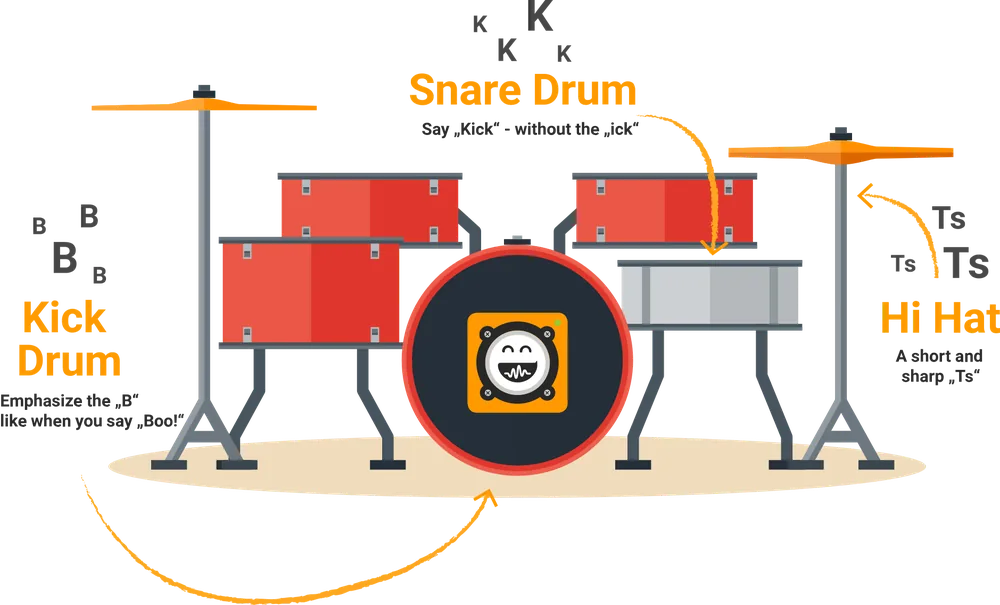
The three sounds, one at a time
The kick drum – B
Push the letter B as hard as you can. Not „bee“ – just the B. Shape your lips a little like a duckface: slightly pursed and tense. When you say the B, you release that tension all at once, like a small explosion. Do not roll your lips inward – that flattens the sound. A test that works: put a small scrap of paper on your lip and try to blow it off with the B. If the paper moves, you have enough pressure. If it will not come, cheat with a vowel first: say „Buh, Bah, Beh“ a few times, then drop the vowel and keep only the B.
The hi-hat – ts
Lift the tip of your tongue and rest it just behind your upper front teeth. Now make a short, sharp ts. Sharp is the whole point – a soft ts disappears inside the beat. If you cannot get the edge, say the word „cats“ and keep only that final hiss. Hold the s longer and you get an open hi-hat: tsss. Cut it short and you get a closed one: ts. Two different sounds from one movement.
The snare – K
Say „Ka“ with force. Then „Key“. Then drop the vowel and keep only the K, short and hard. This is the friendliest snare in beatboxing, which is why every beginner starts here. Later you will replace it with better ones – but not today.
Putting it together
Say the phrase slowly, four times: boots and cats and boots and cats and. Now replace the words with the sounds, still slowly: B – ts – K – ts | B – ts – K – ts.
Keep it slow. Slow and clean beats fast and messy every single time – and slow is what builds the muscle memory that makes fast possible later. When it feels automatic, speed it up a little. If it falls apart, you went too fast; drop back to the speed where it was clean and stay there for a while.
Three things that go wrong
Your beat speeds up on its own
Almost everyone does this. Play along to a metronome at 80 BPM, or to any song you like. Your ear will lock in faster than your mouth will.
You run out of air
You are breathing out on every sound. Breathe in through your nose on the gaps – the „and“ in the phrase is exactly where that breath belongs. Later you will learn sounds that let you breathe in and play at the same time, which changes everything.
Your kick is quiet
That is not a technique problem, it is a muscle problem. The muscles around your mouth have never done this before. They get stronger in a few weeks of short daily practice, and the sound improves on its own.
Where beatboxing came from
Beatboxing grew out of hip-hop in early-1980s New York, when drum machines – „beat boxes“ – were expensive and rare. People imitated them with their mouths instead. There are roughly three traditions. Vocal percussion, the oldest, is rhythm made with the voice inside singing groups and choirs. Old school beatboxing is the 1980s hip-hop style, built on a handful of powerful core sounds. New school is everything that came after: inward sounds, throat bass, sirens, scratches, effects that sound like they were made on a machine. Everything on this page is old school. It is where all of it starts.
What comes after „boots and cats“
Once the beat runs on its own, the next step is a second beat – because switching between two beats is what turns a rhythm into music. Our free beatbox course covers exactly that: ten video lessons, free, no account required.