
Free beginner course
How to Beatbox in 6 Steps
One video, six steps – from your first sound to a finished beat. All you need is your mouth.
The six steps in the video
Tap a step and the video jumps straight to it.
To beatbox you learn three basic sounds – the kick drum („B“), the hi-hat („Ts“) and the K snare („K“) – and combine them into a simple rhythm: B – Ts – K – Ts. That pattern is your first beat.
1 Breathing technique
Beatboxing runs on air, so breathing comes first. The rule is simple: breathe in through your nose during the pauses in your beat. Your mouth is busy making sounds, so your nose takes over the job of refilling your lungs. Build this habit from day one – play a short phrase, pause, breathe in through your nose, and keep going. It feels unusual at first, but after a few sessions it becomes automatic. Later on you will learn sounds like the inward snare, which are made while breathing in – so you can play and inhale at the same time and never run out of air.
2 The hi-hat
The hi-hat is the lightest of the three basic sounds and the best one to start with. Lift the tip of your tongue and place it right behind your upper front teeth. Now release a short, sharp „Ts“. The sound should be crisp, like a whisper with an edge. If your „Ts“ sounds too soft, try a sharply pronounced „Z“ instead and shorten it until only the sharp attack remains. There are two versions: the closed hi-hat is a short „Ts“, the open hi-hat is a longer „Tsss“ where you let the air flow. You will use the closed one in your first beat.
3 The K snare
The K snare is the most popular snare for beginners – simple, loud, and it works in almost any beat. Start by saying „Ka“ with real power and pressure. If that feels awkward, say the English word „Key“ instead, sharp and short. Once the sound has some punch, reduce it: drop the vowel and keep only the hard „K“. That dry, compressed „K“ is your snare. One thing makes it special: the K snare works both while breathing out and while holding your breath, which makes it easy to fit into a beat without gasping for air. Aim for a short, aggressive crack – not a cough.
4 The kick drum
The kick drum is a strongly emphasised „B“. Shape your lips like a duckface: pout slightly and tense them. When you say „B“, that tension releases all at once – like a small explosion. That burst of pressure is what makes the kick sound deep and punchy. One common mistake: do not roll your lips inward – the sound loses all its power. A quick test: place a small piece of paper on your lower lip and try to blast it off with your „B“. If it flies, your pressure is right. Ease into it with vowels – „Buh“, „Bah“, „Beh“ – then shorten them to a dry „B“. Practising in front of a mirror helps you check your lip position.
5 The spoken rhythm
Before you combine your three sounds, speak the rhythm as plain syllables: B – Ts – K – Ts. Say it out loud, slowly and evenly, like four ticks of a clock. This is the classic boots and cats pattern – say „boots and cats and boots and cats“ and you will hear the same rhythm hiding inside the words. Speaking the rhythm first does two things: it locks the timing into your head, and it lets you focus on one problem at a time. Timing now, sound quality in the next step. Keep repeating the spoken loop until you can do it without thinking about what comes next.
6 Your first beat
Now put it together. Take the spoken rhythm from step 5 and replace each syllable with the real sound: the „B“ becomes your kick drum, the „Ts“ your closed hi-hat, the „K“ your snare. Played in a loop – B – Ts – K – Ts – this is a real beat, the same basic pattern you hear in countless pop and hip-hop tracks. Start slowly. It is better to play it clean at a slow tempo than sloppy at a fast one; speed comes on its own with repetition. Remember step 1: breathe in through your nose in the pauses. Once the beat runs smoothly – congratulations, you are beatboxing.
How to read our notation
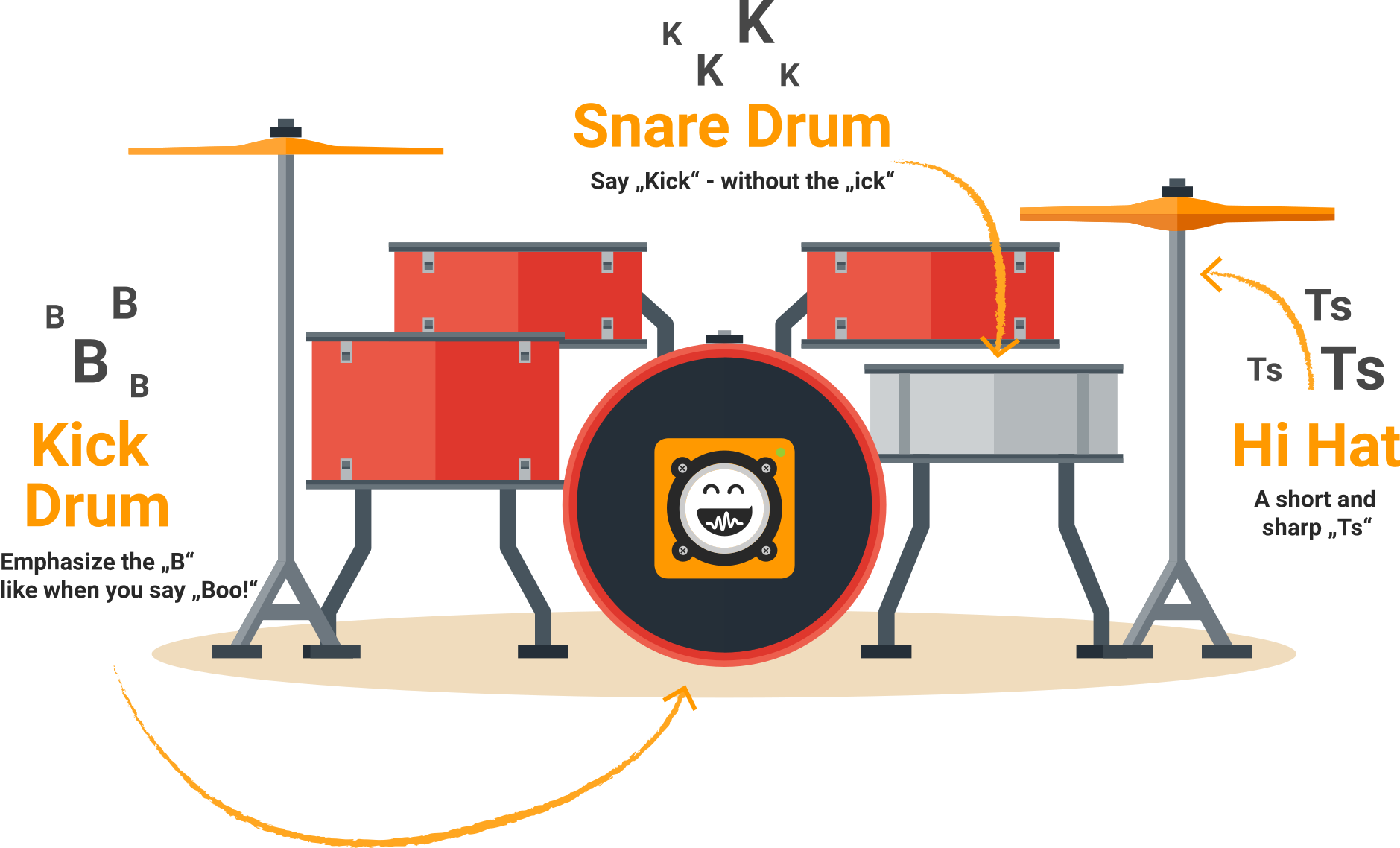
Our beat notation shows you the timing, the breathing and the repetitions. You do not need to read music. Think of your mouth as a small drum kit: the kick drum on your lips, the hi-hat behind your teeth, the snare at the back of your tongue.
Frequently asked questions
Can anyone learn to beatbox?
Yes. You need no equipment and no talent – just your mouth and regular practice. The three basic sounds are built from letters you already use when speaking.
How long does it take?
You can play your first beat within a day, often within an hour. Getting the sounds clean takes a few weeks. Ten minutes a day beats two hours once a week.
Can you beatbox with braces?
Yes. The hi-hat feels different at first because your tongue meets your teeth differently. Most people adapt within a couple of weeks. Start with the kick drum – that one is made with your lips.
Is beatboxing bad for your voice?
Not if you do it right. The core sounds are made with lips and tongue, not with your vocal cords. Warm up, stay hydrated and stop when your throat feels rough.
Keep going with the course
Once your first beat runs, the next step is a second beat – switching between two beats is what turns a rhythm into music. The free course has ten video lessons, no sign-up.