
For singers and choirs
Vocal percussion
Vocal percussion is rhythm made with the voice inside a singing group. It is the oldest branch of beatboxing – and the one built to sit underneath harmony rather than in front of it.
If you sing in an a cappella group or a choir, you already know the problem: the arrangement works, the harmonies work, and it still feels flat, because nothing is holding the time. That is the job vocal percussion does. One voice takes the rhythm section, and suddenly the whole group sits on a groove instead of counting.
How it differs from beatboxing on a stage
A solo beatboxer wants to be loud, wide and surprising. A vocal percussionist wants the opposite: to be tight, quiet and completely predictable. Three practical differences follow from that.
Volume sits under the group
You are the floor, not the ceiling. If people can pick your sounds out of the mix as individual noises, you are too loud. On a microphone this changes: close-miked percussion can be very quiet at the mouth and still carry.
Sounds are shorter
Long, ringing sounds smear the harmony. Cut the hi-hat short, keep the kick dry, and let the singers own the sustain.
Consistency beats variety
In a battle, repeating yourself is a weakness. In a choir it is the entire point. The same kick, in the same place, for three minutes.
The three sounds you actually need
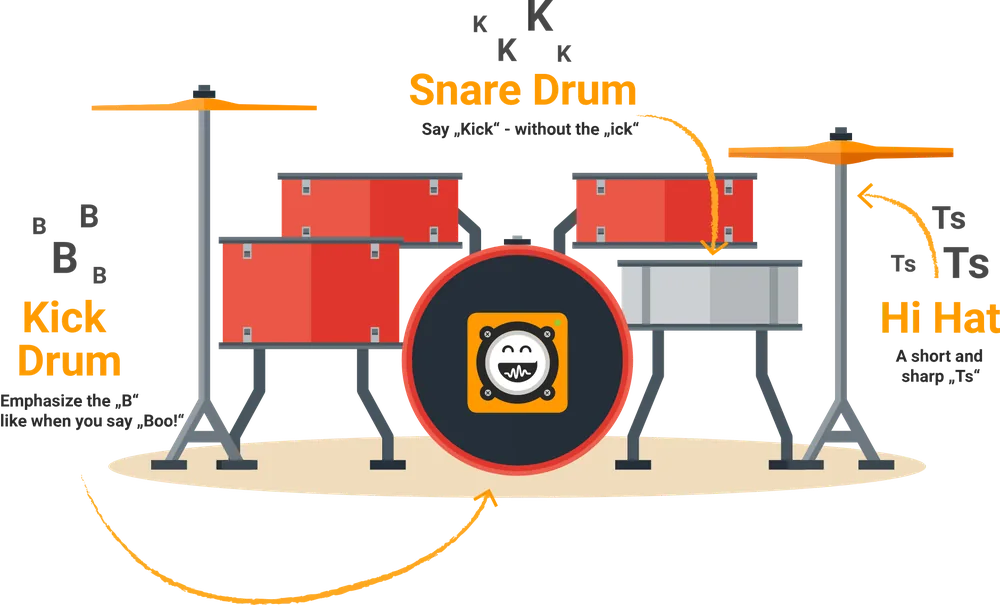
You can accompany most songs with three sounds and nothing else: a kick drum (a compressed „B“), a closed hi-hat (a short, sharp „Ts“) and a snare (a hard „K“, or a „Pf“ if you want it softer). Put them in the pattern B – Ts – K – Ts and you have a straight backbeat that fits pop, gospel and most folk arrangements.
Breathing, so you can hold a whole song
This is where most singers struggle first. You cannot breathe out for three minutes. The rule is the same as in beatboxing: breathe in through your nose in the gaps of the pattern. Once that is automatic, the inward snare – a snare made while breathing in – removes the problem entirely, because you refill your lungs on every backbeat.
Is it bad for the voice?
Not when it is done correctly. The core sounds are made with lips and tongue, not with the vocal folds, so they put very little strain on the voice. Problems appear when people push volume from the throat. Warm up, stay hydrated, keep the effort in the mouth, and stop if the throat feels rough. A percussionist who also sings in the same set should be especially careful with throat bass.
Learn the sounds properly
Our free course covers all three core sounds, the breathing and the first patterns – all course videos, free, no account needed. It is the same structure we use when we coach choirs.